How to Decide Which Confidence Interval to Use
The key to understanding this is to realize that a level C 1 α 100 confidence interval gives us the same results as a hypothesis test using a level of significance α. It can also be written as simply the range of values.
Understanding Confidence Intervals Easy Examples Formulas
The number of observations n.

. To use a confidence interval simply make the following observations. Probably the most commonly used are 95 CI. σ M 1118.
Choose a confidence level that best fits your hypothesis like 90 95 or 99 and calculate your margin of error by using the corresponding equation. Suppose that you do a hypothesis test. If 0 is not in the confidence interval Drug 2 will be deemed more effective and will be recommended over Drug 1 resulting in much greater cost for the patient than if Drug 1 were used.
We use the following formula to calculate a confidence interval for a proportion. We should use the standard deviation of the entire population but in many cases we wont know it. Alpha required argument This is the significance level used to compute the confidence level.
Find the difference between the 2 numbers 221-147 74. Find the Z value for the selected confidence interval. The following steps show you how to calculate the confidence interval with this formula.
Your desired confidence level is usually one minus the alpha a value you used in your statistical test. Find the margin of error The margin of error of your sample represents the number of. Decide the confidence interval that will be used.
Choosing a confidence interval range is a subjective decision. Divide that number by 2 because that will tell you what was added to and subtracted from the mean. Find the standard error Using the sample mean and standard deviation calculate the standard error of the sample.
Confidence Interval Excel Formula CONFIDENCEalphastandard_devsize The CONFIDENCE function uses the following arguments. Confidence Interval p - z p 1-p n where. To use the confidence interval approach we use the following rule.
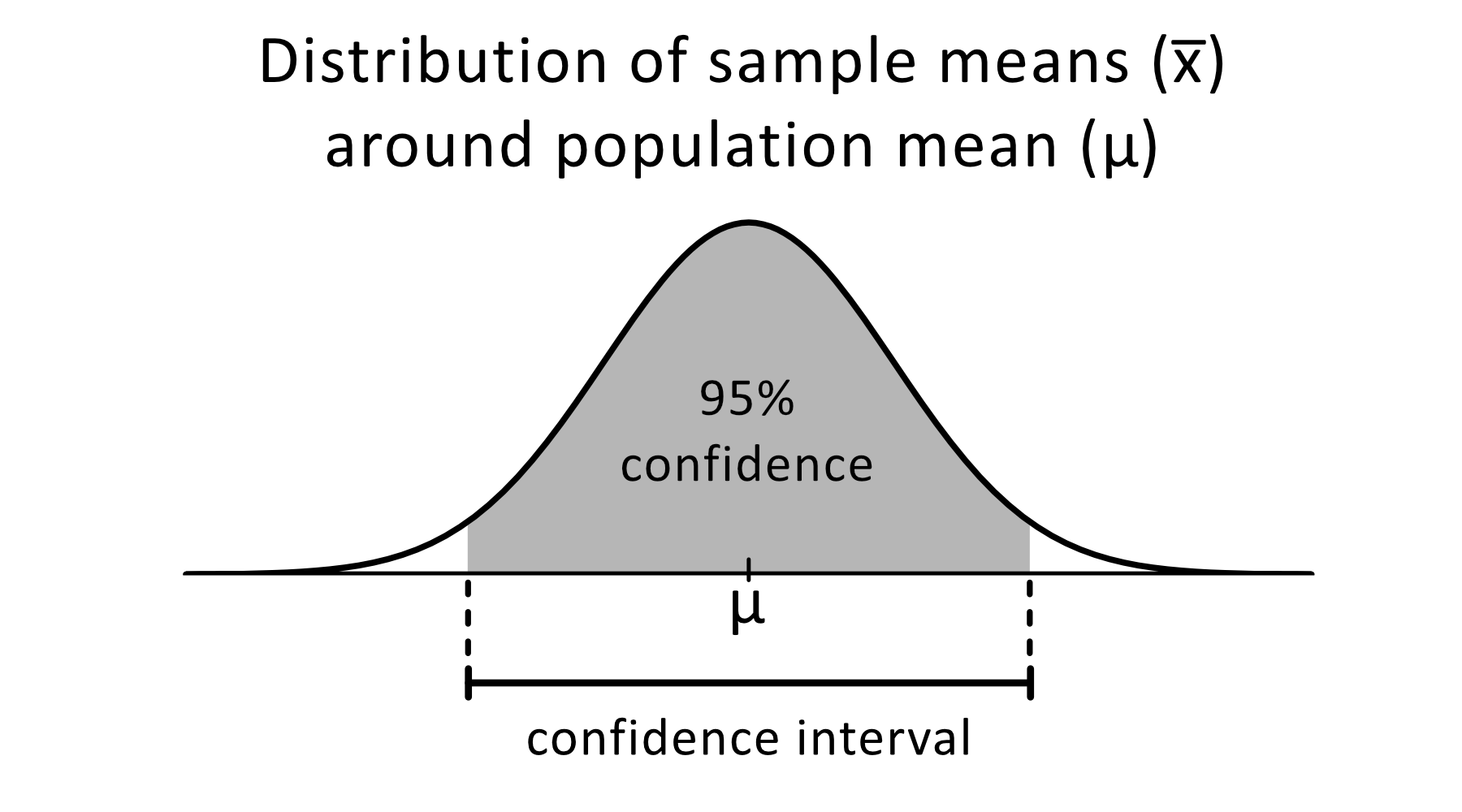
In our example lets say the researchers have elected to use a confidence interval of 95 percent. If μ0 μ 0 lies within the range of the confidence interval do not reject H 0 H 0. If μ0 μ 0 lies outside the range of the confidence interval reject H 0 H 0.
The size of the sample necessary to generate a confidence interval for the population mean with a given level of confidence is calculated with the following formula. For example a 95 confidence interval can be used in place of a hypothesis test using a significance level α 005 5. How to determine the confidence interval for the unknown theta parameter of the Uniform 0 θ -distribution using the central limit theorem considering that the significance level is given and θ 0.
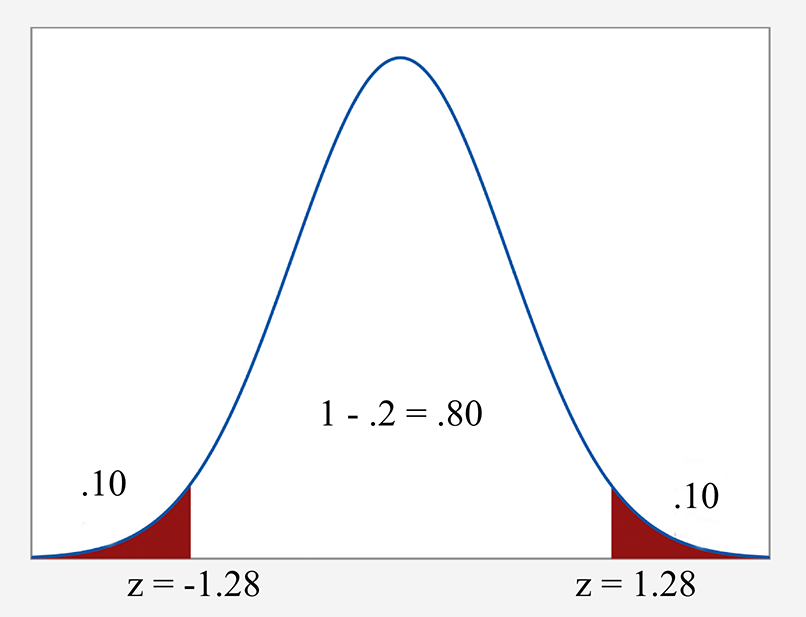
Despite the fact that the decision of confidence coefficient is to some degree discretionary anyway we typically utilize 90 95 and 99 intervals. Next well calculate the total alpha value. And the standard deviation s.
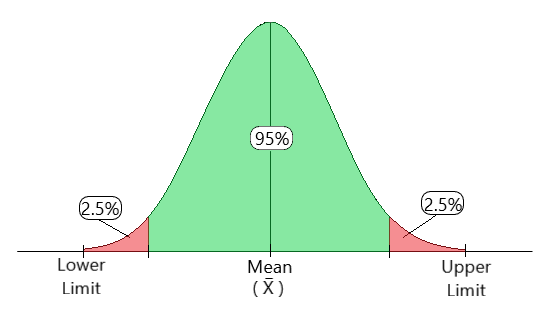
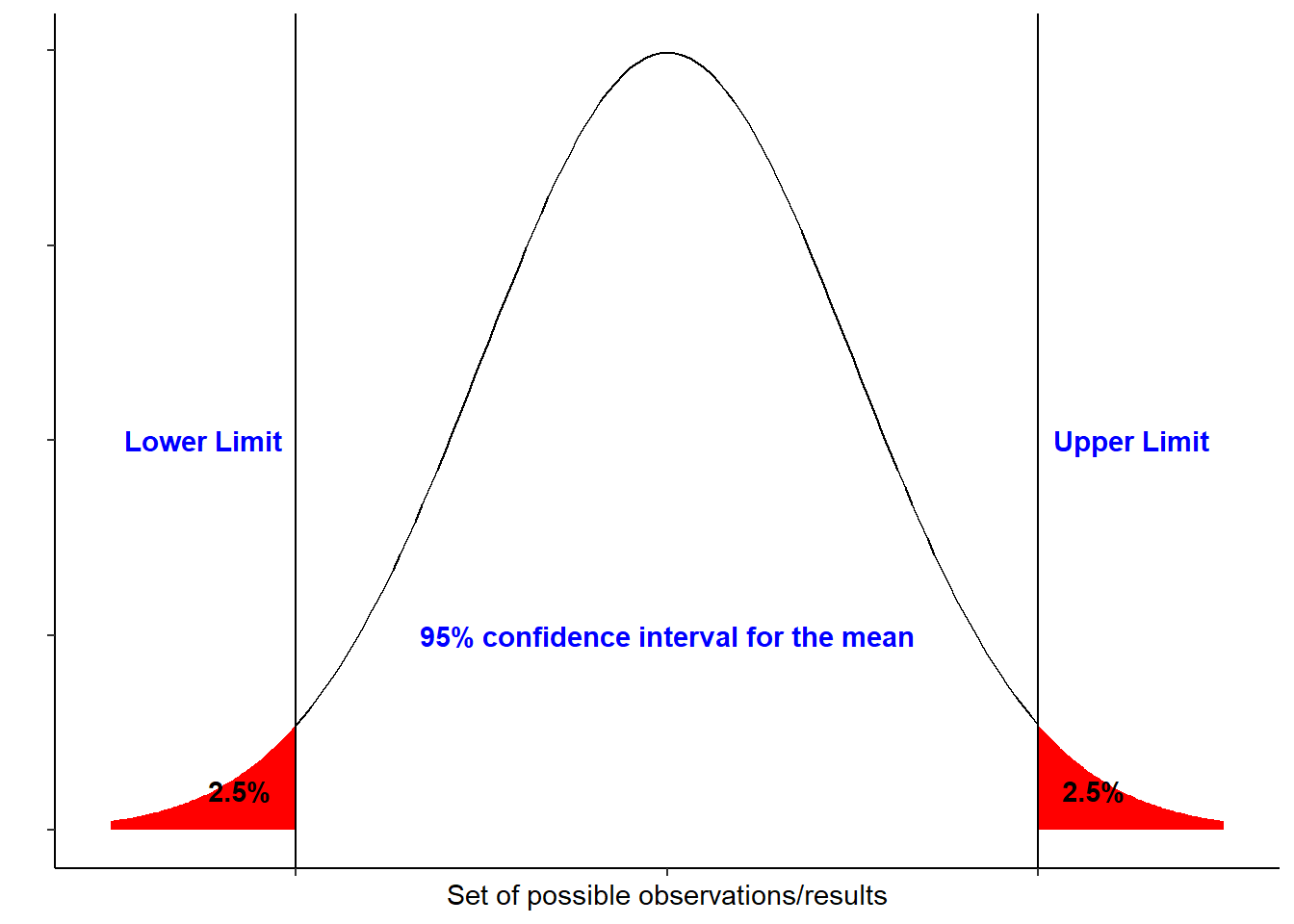
This is the small section of the graph above and below our 95 range of. If the p-value is less than or equal to α you reject H 0. So a significance level of 005 is equal to a 95 confidence level.
If 0 is in the confidence interval this will be taken as of. Divide the alpha value by two so we can separate the. When generating the sample theta should be considered as known and afterwards should be checked whether or not its in the interval.
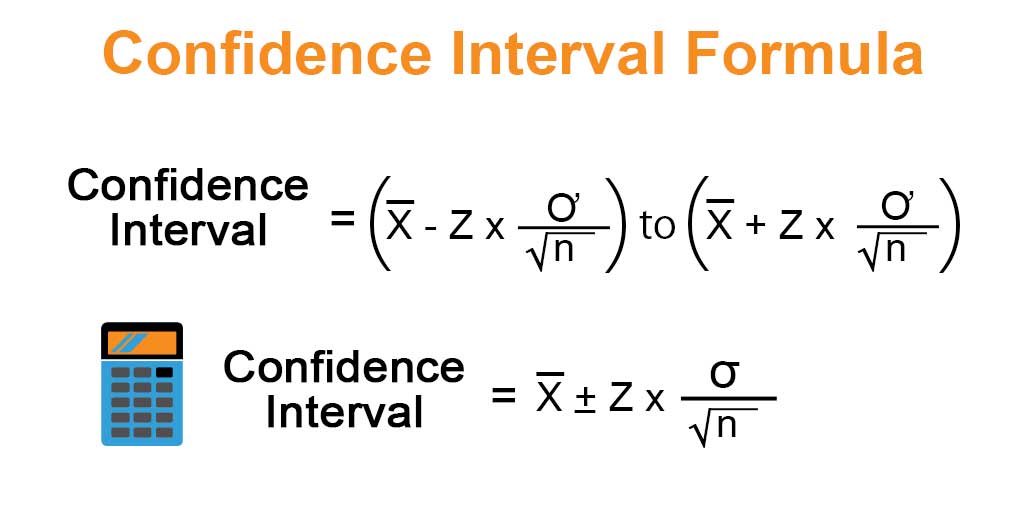
CI Point estimate Margin of error where the margin of error is given by the product of a critical value z derived from the standard normal curve and the standard error of point estimate. So we get 742 37 for the margin of error. Eqn Big frac z.
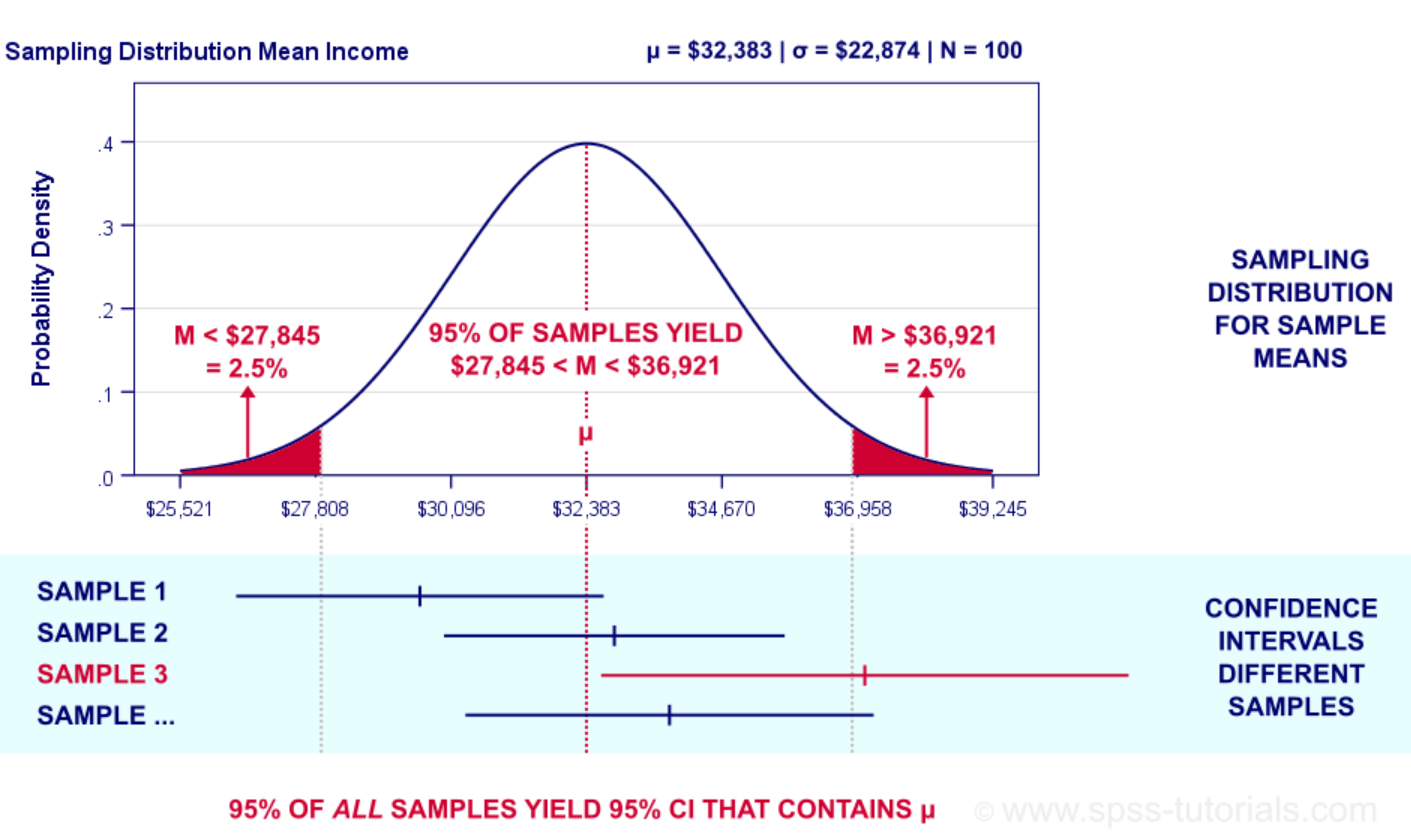
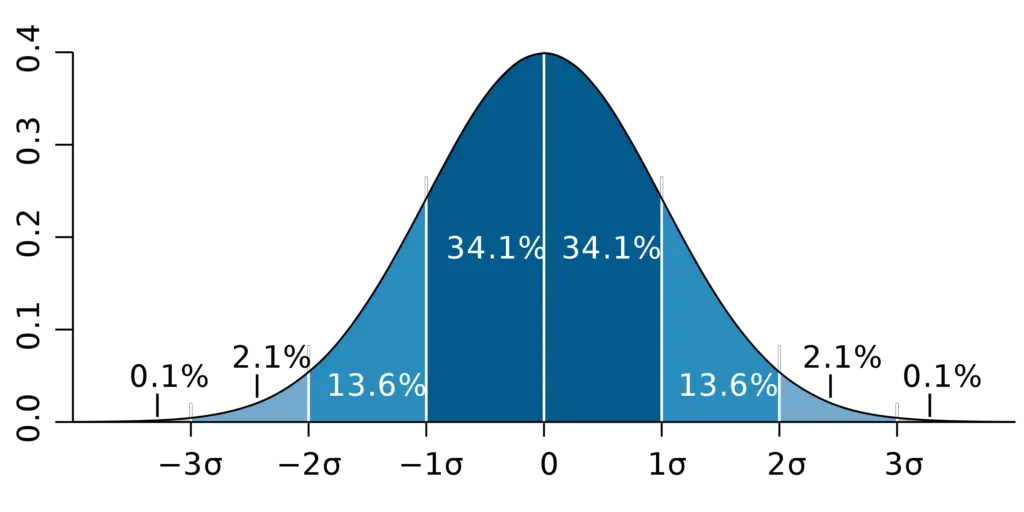
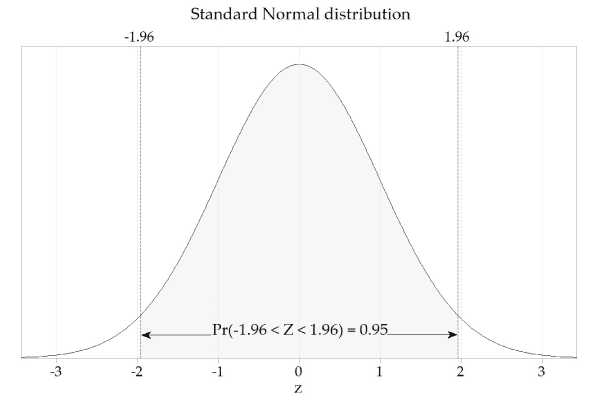
You can determine a confidence interval by calculating a chosen statistic such as the average of a population sample as well as the standard deviation. Z95 can be found using the normal distribution calculator and specifying that the shaded area is 095 and indicating that you want the area to be between the cutoff points. The range can be written as an actual value or a percentage.
95 confidence interval sensitivity 196 SE sensitivity Where SE sensitivity square root sensitivity 1-sensitivityn sensitivity 95 confidence interval specificity 196 SE specificity pin pnn. Calculation of the CI of a sample statistic takes the general form. Suppose we want to estimate the proportion of residents in a county that are in favor of a certain law.
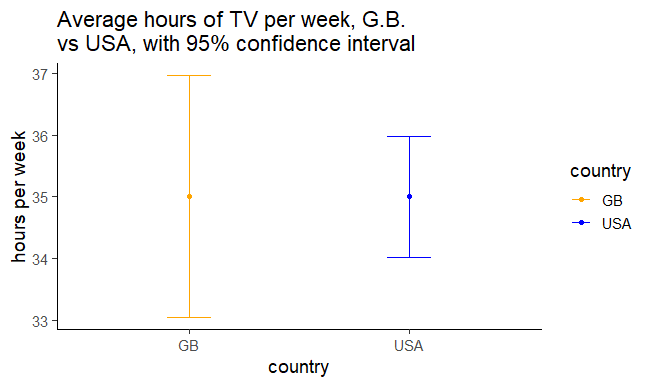
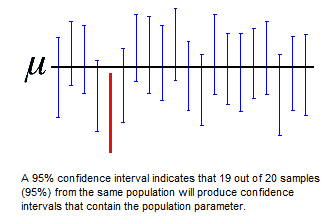
Or 19713 21487 Calculating confidence intervals. A 95 confidence interval doesnt imply that there is a 95 likelihood that the interval includes the real mean. To compute the 95 confidence interval start by computing the mean and standard error.
How do you find the 95 confidence interval for sensitivity and specificity in SPSS. So if you use an alpha value of p 005 for statistical significance then your confidence level would be 1 005 095 or 95. It is about how much confidence do you want to have.
In this case our sample. Mean pm z fracSDsqrt n Where SD standard deviation and n is the number of observations or the sample size. We use a formula for calculating a confidence interval.
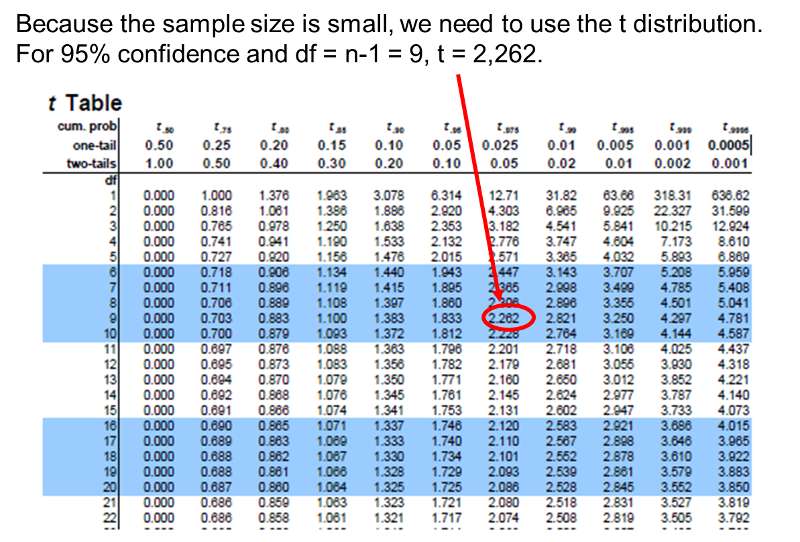
This range is the confidence interval CI which is estimated on the basis of a desired confidence level. You could choose literally any confidence interval. Start by calculating our degrees of freedom by simply subtracting one from our sample size.
The significance level is equal to 1 confidence level. Confidence level 1 a. For example the following are all equivalent confidence intervals.
Confidence limits are conveyed in words of a confidence coefficient. The confidence interval is for proportion of patients for whom Drug 2 is effective - proportion of patients for whom drug 1 is effective. The confidence interval is the range between the sample mean minus E and the sample mean plus E.
Remember that the decision to reject the null hypothesis H 0 or fail to reject it can be based on the p-value and your chosen significance level also called α. Using a confidence interval to decide whether to reject the null hypothesis. Calculating the Confidence Interval.
M 2 3 5 6 95 5. 95 percent and 99 percent confidence intervals are the most common choices in typical market research studies. The z value is taken from statistical tables for our chosen reference distribution.
Confidence intervals are typically written as some value a range.
Understanding Confidence Intervals Easy Examples Formulas

The Confidence Intervals Correspond To 3 Sigma Rule Of The Normal Download Scientific Diagram

How To Calculate Confidence Interval 6 Steps With Pictures
Confidence Intervals
Confidence Interval Formula Calculator Example With Excel Template

Significance And Confidence Intervals Skillsyouneed

Data Analysis In The Geosciences
Machine Learning Why Use Confidence Intervals Data Analytics

The Confidence Interval In Method Validation
Confidence Intervals And Z Score Programmathically

Confidence Interval An Overview Sciencedirect Topics
Confidence Interval Geeksforgeeks
Content Calculating Confidence Intervals
Confidence Interval Calculator
Confidence Intervals For Sample Size Less Than 30
When Should I Use Confidence Intervals Prediction Intervals And Tolerance Intervals
Lesson 5 Confidence Intervals
Why Is A 99 Confidence Level Wider When Constructing Confidence Intervals Quora
Calculating Confidence Interval In R R Bloggers


Comments
Post a Comment